

Session · Asia
Asian Session Backtester
The Asian session is the one most traders backtest by accident — it sits in their sample, contributes a third of the candles and none of the setups, and quietly drags every average they compute. It is worth testing deliberately, if only to find out what excluding it does to your numbers.
Range formation, not a killzone
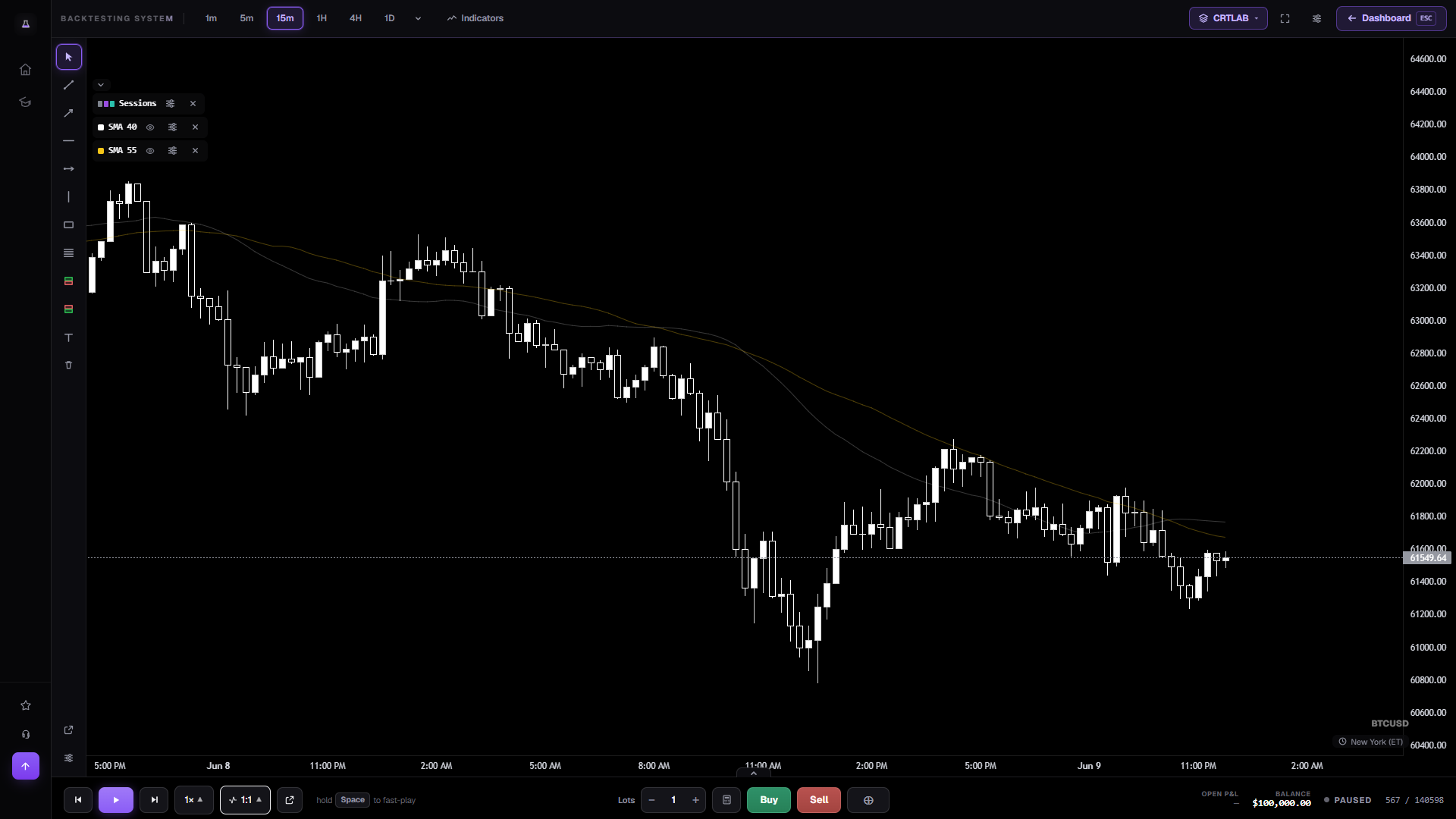
CRTLAB shades the Asian Range from 20:00 to 00:00 New York time, and it is tagged as range formation rather than as a killzone — because that is what it is for. The session's job in most methods is to build the level that a later session takes, not to produce the trade itself.
Which means the honest Asian-session test is usually a test of the London open: how often the range holds, how often it breaks cleanly, how often it gets swept and reversed. That is a London session backtest with an Asian-range input, and running it as one experiment rather than two is what makes the numbers comparable.
The thin-market caveat, stated honestly
Asian-session price on the FX majors is genuinely thin, and thin price produces flat candles and occasional gaps. CRTLAB's feed is real rather than smoothed, so that is what you will see — a run of 1-minute candles with almost no range on EURUSD at 22:00 New York time is the market, not a data fault.
For a backtest this matters twice. It means a stop measured in a few pips is far more likely to be hit by noise than by a move, and it means any strategy whose sample is dominated by Asian-session candles is being measured against conditions it will rarely trade in.
The pairs where Asia is the main event
USDJPY and AUDUSD are the two majors with real business happening during the session — Japanese and Australian data, and the Chinese releases the Aussie is most sensitive to. On those pairs the Asian session is frequently directional rather than a range, which breaks the standard "mark the range, trade the London break" assumption entirely.
That is the finding worth having: run the identical Asian-range test on EURUSD and on AUDUSD and the difference between the two results is the whole lesson.
Frequently asked questions
What time is the Asian session on the chart?
CRTLAB shades it 20:00–00:00 New York time, tagged as range formation. Session shading paints at 5 minutes and below.
Why do the Asian candles look flat?
Because they are. The feed is real rather than smoothed, and FX majors genuinely trade in a narrow range during Asian hours — that flatness is information, and any strategy sized for London volatility will behave differently in it.
Should I exclude the Asian session from my backtest?
Measure it before you decide. Split your existing log by session: if the Asian-session trades are a meaningful share of the sample and a negative share of the result, you have found a filter rather than a problem with the strategy.
Is it free?
Yes — every market, every session overlay, on the most recent two weeks of data with no account.
Open USDJPY with the Asian range shaded
One click — 5-minute yen, the range building live, key levels and equal highs marked.
Open the chart →