

Backtest · NAS100
Backtest NAS100 — Candle by Candle, Free
NAS100 is the index that rewards precision and punishes hesitation. Backtesting it on real historical price — one candle at a time — is how you learn its rhythm before it costs you money. Here's why traders backtest the Nasdaq, what makes it different, and how to do it properly in CRTLAB.
Why backtest NAS100?
NAS100 moves fast. A clean setup and a sloppy entry can be 40 points apart, and on the Nasdaq that's real money. The traders who stay calm in that speed aren't gifted — they've just seen the setup play out hundreds of times in replay, so they know what's noise and what's signal.
Backtesting answers the questions live trading can't afford to: how often does your setup actually appear on NAS100, what's your real win rate across a few hundred occurrences, and which part of the session does it work best in? You can't feel your way to those numbers — you have to count them.
What makes NAS100 different to backtest
The Nasdaq is the most volatile of the major US indices — tech-heavy, sensitive to yields and big-cap earnings, and prone to violent expansion right off the New York open. Its opening drive can run further in ten minutes than some pairs move in a day, which is exactly why timing and session context matter so much when you test it.
That volatility also means position sizing isn't optional. A 25-point stop and a 100-point stop are wildly different risk on NAS100 — size each test correctly with the position size calculator so your backtest reflects real risk, not a fantasy. When you replay it, pay attention to how price sweeps the prior session's high or low before it expands — that behaviour repeats on the Nasdaq more than almost anywhere.
How to backtest NAS100 in CRTLAB
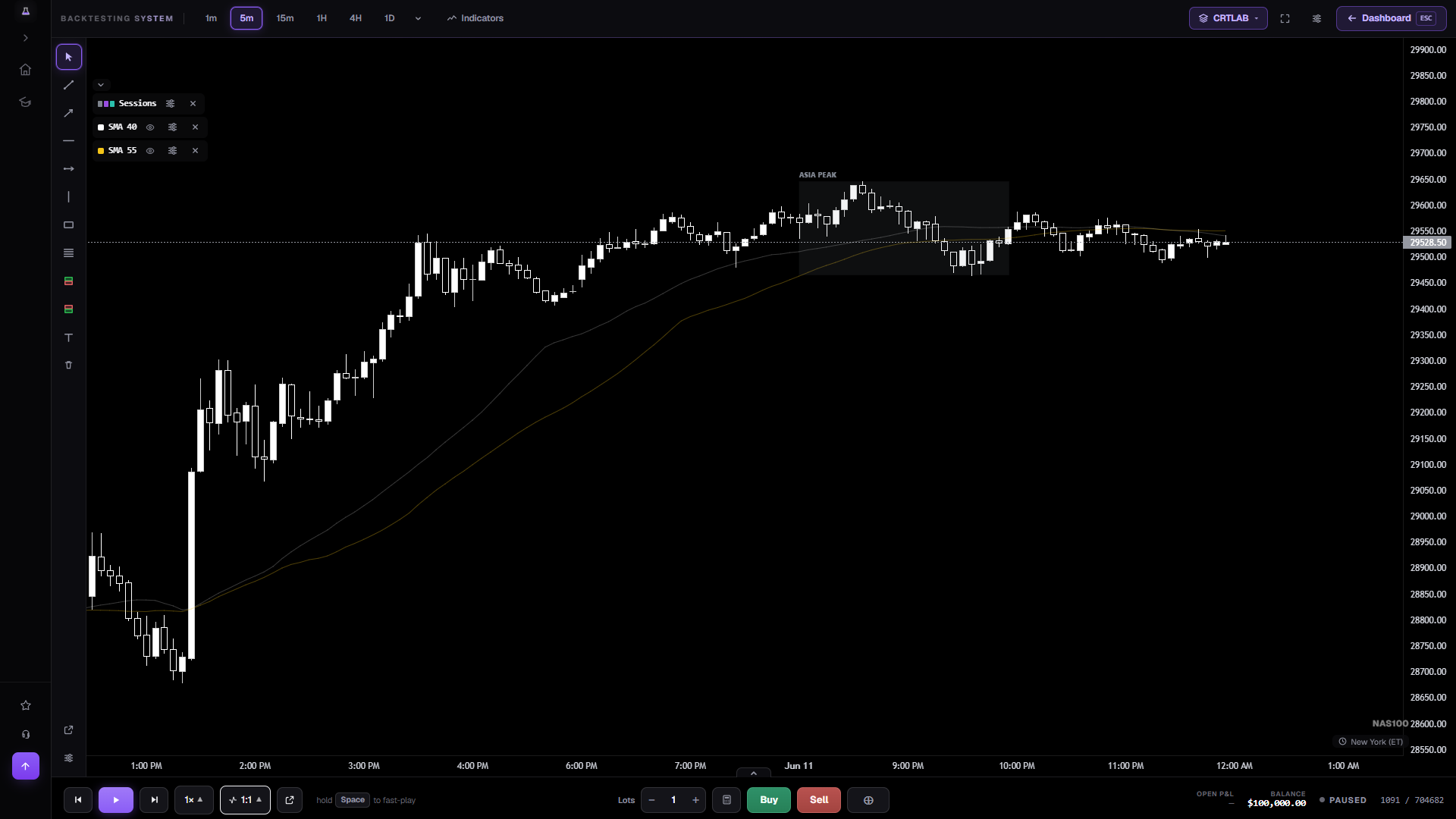
Pick NAS100, drop into real historical price, and step forward one candle at a time — you only ever see what you'd have seen live, so hindsight can't creep in. When your setup forms, mark the entry, stop and target exactly as your rules dictate, then log the outcome. After 50–100 setups you'll have an actual win rate and average R instead of a hunch.
The free tier gives you NAS100 on the most recent two weeks of data — enough to feel the engine and put in real screen time, no card needed. Pro opens up ten years of Nasdaq history, so you can test your edge across bull runs, corrections and chop, not just this fortnight's conditions.
Frequently asked questions
Can I backtest NAS100 for free?
Yes. The free tier lets you replay NAS100 candle by candle on the most recent two weeks of real data — no card, no trial timer. Pro unlocks the full ten-year history.
What's the best timeframe to backtest NAS100?
Test the timeframe you actually trade. Intraday Nasdaq traders usually work a 1–5 minute chart inside higher-timeframe session context; swing traders test the hourly. The point is consistency — pick one and log every setup on it.
Why backtest NAS100 instead of just trading it live?
Live trading an untested setup is expensive tuition. Backtesting gives you the win rate, average R:R and worst-case drawdown across hundreds of NAS100 setups before you risk a cent — so when a losing streak hits, you know it's variance, not a broken edge.
Backtest NAS100 free — no card needed
Replay the Nasdaq candle by candle on real data and prove your edge. Start free in 30 seconds.
Start backtesting free →