

Concept · Market Structure
Market Structure Backtester (MSS / BOS)
Market structure is the one concept every method agrees on and almost nobody tests. Higher highs, lower lows, and the moment the sequence breaks — it is mechanical enough to detect and therefore mechanical enough to count. Which means your "structure shifted, so I entered" is a hypothesis with a hit rate, not a description.
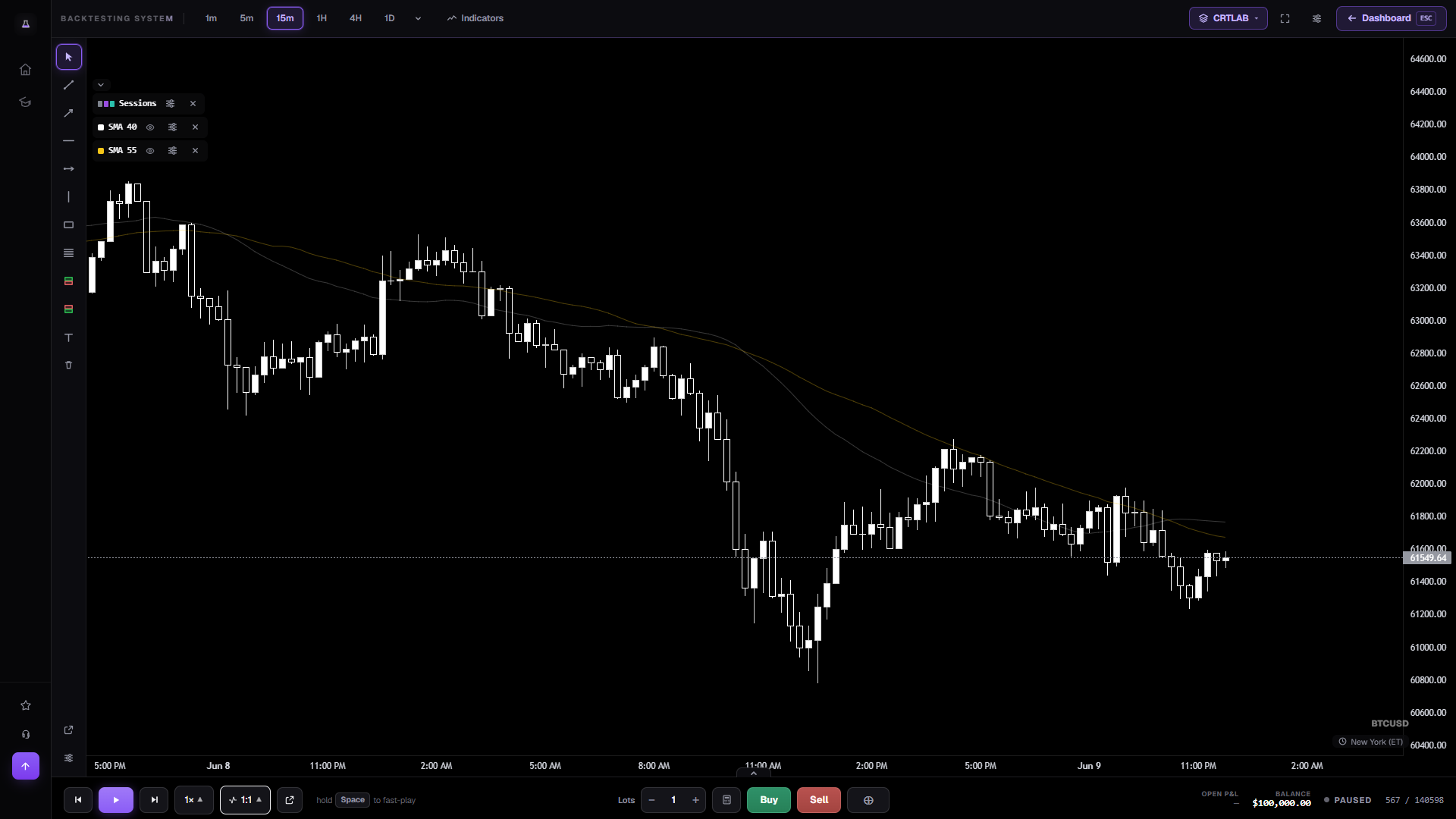
BOS, CHOCH, MSS — one mechanism, three names
A break of structure is price closing beyond the last significant swing in the direction of trend: the trend continued, and now there's proof. A market structure shift (or change of character) is the same break against the trend: the sequence that had been making higher highs just made a lower low, and the character of the move changed.
The vocabulary varies by teacher; the geometry does not. CRTLAB detects the swing sequence and marks the break at the candle that confirmed it — which is the part hindsight quietly cheats on. A swing point is only a swing point once enough candles have printed either side of it, and a chart that marks it retroactively is showing you information you did not have. Market structure explained walks the full sequence.
The question a structure backtest answers
"How often does a shift actually lead anywhere?" Every method built on structure assumes a break is predictive. Test it: log every confirmed break for a few hundred occurrences and record what happened over the next N candles. You'll usually find the answer depends far more on where the break happened than on the break itself — which is a real finding, and it's the one that turns a rule into an edge.
The second question is cost. Structure breaks cluster in chop: a range produces a break, then an immediate opposite break, then another. If your rules don't have an answer for that, the backtest will tell you in the drawdown column.
How to run it
Open a chart, switch on market structure, and step forward. Take only the breaks your written rules would have taken — if you can't state the rule in a sentence before the candle prints, you don't have a rule, you have a preference. How to write trading rules you can backtest is the short version of getting that right.
Stack it: structure plus a liquidity sweep into the break, or structure plus the fair value gap the displacement left behind. Those combinations are what most people mean when they say they trade structure, and testing them separately is why so many backtests don't resemble the strategy.
Frequently asked questions
Does it mark BOS and CHOCH separately?
The detector marks structure breaks and labels the direction; a break with the trend is what most people call BOS, and one against it is CHOCH or MSS. Same geometry, and both are drawn at the confirming candle.
Is market structure detection free?
Yes — every concept overlay is free, on all 21 free markets, for the most recent two weeks of data. No account needed to open a chart with it on.
Can I backtest structure on higher timeframes?
Yes. The detector runs on every timeframe from 1 minute to weekly, and switching timeframe rebuilds it from scratch rather than reusing a lower-timeframe swing sequence.
How many structure breaks do I need to log?
Enough that variance can't explain your result. For an edge you believe is a few percent above coin-flip, that is hundreds rather than dozens — the sample size calculator turns your assumed win rate into an actual number.
Open EURUSD with market structure marked
One click — 15-minute chart, every break drawn at the candle that confirmed it.
Open the chart →