

Backtesting Software
Backtesting Software — Test Your Edge on Real Market History
Most people shopping for backtesting software buy the wrong kind, because the phrase covers two products that have almost nothing in common. One runs code over ten years of data in four seconds. The other hides the right-hand side of the chart and makes you click every trade yourself. Buy the wrong one and it sits unopened. Here's how to tell which you need, what the real options cost, and where CRTLAB fits.
Backtesting software means two different things
Automated backtesters take rules written as code and run them over years of history in seconds. You get thousands of trades, a parameter sweep and an equity curve before you've finished your coffee. MetaTrader's Strategy Tester, Python libraries like backtrader, and the strategy engines built into charting platforms all live here.
Manual replay tools do the opposite. They hide everything to the right of the current candle and step price forward one bar at a time while you read the chart and click your own entries, stops and targets. No code, no optimiser, no thousands of trades — you get however many setups you can work through by hand.
The mistake is buying across the divide, and it's extremely common: discretionary traders buy an optimiser, discover their setup can't be expressed as code, and never open it again; mechanical traders buy a replay tool and spend three weeks clicking through what a script would have answered in an afternoon.
There's a clean test for which side you're on. Could a stranger read your rules, never see the chart, and take exactly the trades you'd take? If yes, your strategy is mechanical — automate it. If your honest answer involves the words "it depends" or "you'd see it", it's discretionary, and no optimiser can test it. Replay is the only honest option. If you're not sure which you have, that ambiguity is itself the finding — writing rules precisely enough to be testable settles it faster than any software will.
The real options, compared
Every serious tool in this space is good at something and bad at something else, and the marketing never tells you which. Here's the honest version.
| Tool | Built for | The catch |
|---|---|---|
| TradingView Bar Replay | Manual replay inside a charting platform you may already pay for. | Intraday replay sits behind the paid tiers and replay depth is limited by plan. Full breakdown on our TradingView Bar Replay alternative page. |
| MetaTrader Strategy Tester | Automated testing of Expert Advisors on your broker's own tick data. Free. | It tests programs, not people. Clicking your own trades needs a third-party button-EA, and the EA only registers a press when a new tick arrives. See the MetaTrader page. |
| Forex Tester | Deep manual replay on a desktop app with decades of data and hundreds of symbols. | Paid licence plus a data package, Windows-first, and you commit before you know whether you'll stick with backtesting. See the Forex Tester page. |
| FX Replay | Browser-based manual replay with checklists and trade review. | The free plan is capped at 2 sessions, 50 trades and 1 week of data retention; Pro is $35/month or $350/year. Full comparison on our FX Replay alternative page. |
| Coding it yourself | Total control, any market, any logic, free but for your time. | You are now maintaining software instead of testing a strategy, and every bug reads as a result. Only worth it for genuinely mechanical rules. |
| CRTLAB | Manual candle-by-candle replay in the browser on 38 markets, with every trade logged and scored automatically. | It doesn't run Expert Advisors, optimise parameters or import your own data. If your strategy is mechanical, use a coded backtester instead. |
Third-party plan limits and prices above were checked against each vendor's own pricing page on the date shown at the top of this page. These vendors run frequent sales — check their current pricing yourself before deciding.
What good backtesting software should do
Four things separate real backtesting software from a chart you can drag. It should replay real historical data bar by bar so hindsight can't creep in. It should log every trade and turn them into stats — win rate, average R, profit factor, drawdown. It should cover the markets you actually trade. And it should be fast enough that you can run hundreds of setups without it becoming a chore.
That last one gets dismissed as a nice-to-have and it is the one that decides whether you finish. A sample of 100 setups is not a big ask; at two minutes of clicking per setup it's a few evenings, and at ten it's a project you abandon. The arithmetic of backtesting throughput is worth doing before you pick a tool, not after.
The one feature that decides whether your results are real
If the software lets you drag the chart backwards and forwards freely, you will do it. Not deliberately — you'll nudge it two candles to "check", and you'll have seen the outcome before you marked the entry. That is the entire mechanism behind traders reporting 90% win rates in testing and 40% live. It isn't dishonesty, it's that the tool made the honest version optional.
Real replay makes it impossible rather than discouraged: the right-hand side does not exist, you commit before the next candle prints, and a trade you'd have skipped live is a trade you skip here. Everything else on a feature list is secondary to that one property. The related failures — cherry-picking the sample, quietly editing rules mid-test, calling twenty trades a result — are covered in the seven mistakes that make backtest results worthless.
Watch for the subtler version too. Software that fills you at a level price merely touched, or that lets you enter on a candle only after seeing it close, is producing a result you cannot reproduce live. That gap has a name and a size — why backtest results differ from live trading puts numbers on it.
How to choose, in three questions
1. Is your strategy mechanical or discretionary? Answered by the stranger test above. This decides the category, and nothing else matters until it's settled.
2. Do you need your broker's exact data? If your rules hinge on a level being taken by a fraction of a point, or on spread at a specific hour, you need tick data from the feed you trade — that's MetaTrader or a desktop app with imported data. If you're testing structure, sweeps and session behaviour, any honest feed answers the question, and arguing about the last 0.2 of a pip is a way of avoiding the test.
3. How many setups can you realistically get through in a week? Multiply it by four. If that number isn't in the low hundreds, your bottleneck is throughput, not features — and you should pick whichever tool gets you from opening it to clicking a trade fastest, then optimise later.
Two questions that feel important and aren't: how many symbols the tool offers (you will test one or two, seriously, and testing thirty is how correlated markets inflate an apparent sample), and how many years of history it holds (until you've logged a few hundred trades, depth is not your constraint).
What it costs, and what you should pay to start
Browser-based replay tools run roughly $15–35 a month. Desktop simulators are sold as a licence plus a data package and run into the hundreds one-off. Automated testers built into trading terminals are typically free, because the broker wants you trading. Coding it yourself is free and costs you weeks.
You should not pay anything to start. Every credible option in this space has a free tier or a demo, and the honest reason to upgrade is not features — it's history depth. A free plan gets you enough real data to learn the tool and find out whether you'll actually sit down and do the reps. Only when you've logged a hundred trades and want to know whether your edge survives a different market regime does more history become the thing standing in your way. Buying depth before that is buying a bigger library before you've read a book.
What CRTLAB gives you
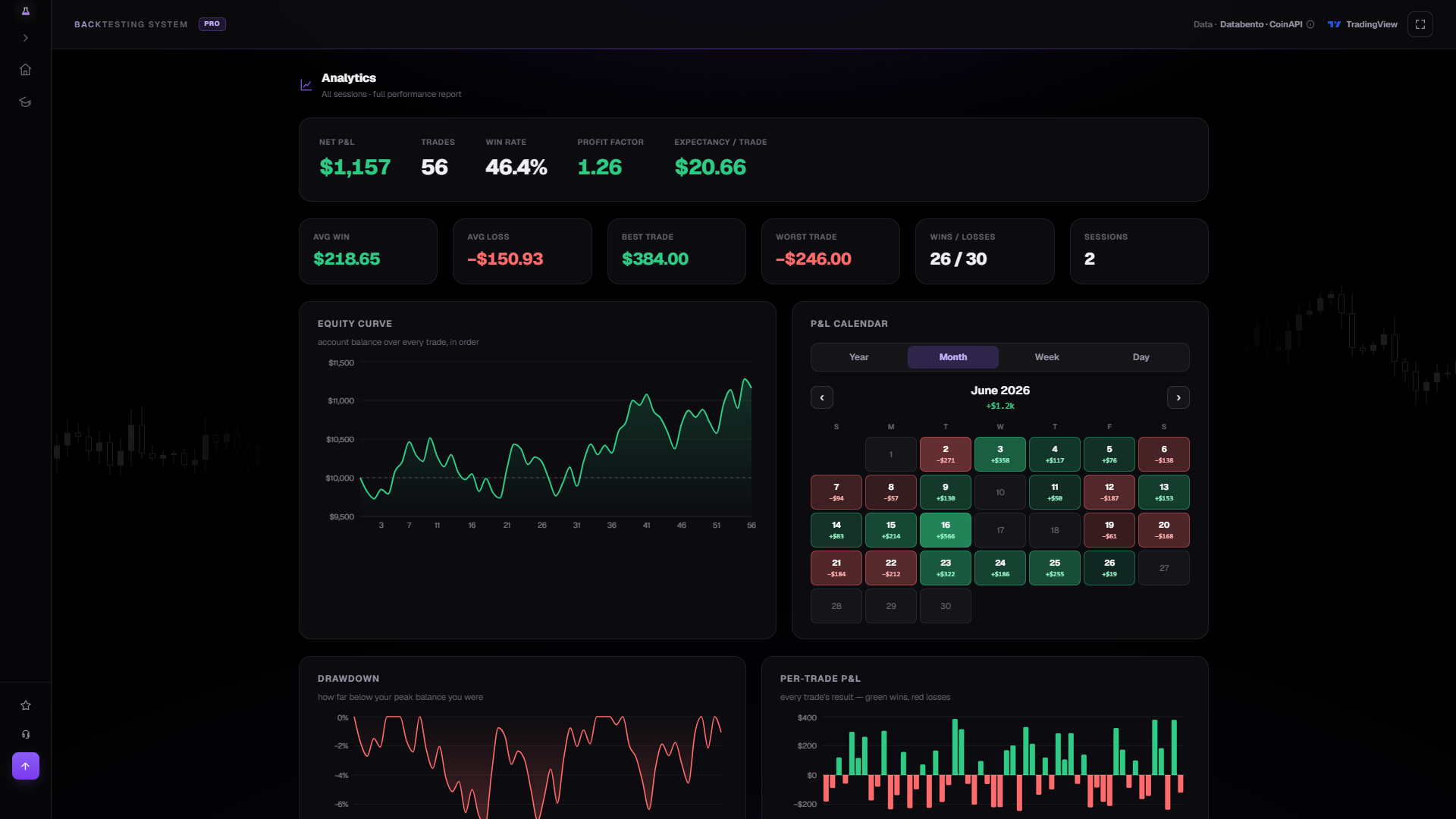
CRTLAB is browser-based backtesting software built around candle-by-candle replay — the manual side of the divide, deliberately. 38 markets: 17 US stocks and ETFs, seven crypto pairs, NAS100, US30, SP500, EURUSD, GBPUSD, USDJPY, gold, silver, oil and Bitcoin — replayed on real data, with your win rate, average R and profit factor tracked automatically as you go. It also ships with the CRT × Mitigation strategy and a full ICT course if you want a method to test rather than one to invent.
The free tier gives you 21 of the 38 markets — everything except the US stocks and ETFs — on the most recent two weeks of real data, every timeframe including intraday, no card, running in about 30 seconds. Pro ($29/month) unlocks all 38 markets with up to ten years of history each, plus the complete strategy and course, and you cancel it in one click.
Size each test properly while you're at it — a backtest that ignores position sizing isn't reflecting real money. The position size calculator takes about ten seconds per market, and the backtest sample size calculator will tell you when you've logged enough trades for the result to mean anything.
Frequently asked questions
Is there free backtesting software?
Yes. CRTLAB's free tier replays 21 of the 38 markets candle by candle on the most recent two weeks of real data, on every timeframe, tracks your stats and needs no card. MetaTrader's Strategy Tester is free for automated testing, and TradingView, Forex Tester and FX Replay all offer free tiers or demos with various caps. Free is genuinely enough to find out whether you'll do the reps.
What's the best backtesting software for beginners?
Whichever one gets you from opening it to clicking your first trade fastest, and that almost always means a browser-based manual replay tool. Beginners nearly always trade discretionary setups, which optimisers cannot test, and installing a desktop simulator plus choosing a data package is three decisions before you've made the first one.
Do I need to know how to code to backtest?
Only if your strategy is mechanical enough to be expressed as code — and if it were, you'd know, because a stranger could read your rules and take your trades. For discretionary reading of structure, sweeps and session behaviour, coding is the wrong tool entirely. CRTLAB is visual: you read price and mark trades with your own eyes.
Can I backtest on TradingView?
Yes, with Bar Replay — but intraday replay sits behind the paid tiers and how far back you can replay depends on your plan, which is the wall most people hit on the free plan. Our TradingView Bar Replay alternative page breaks down exactly what each tier gives you.
Is manual backtesting as good as automated?
For a discretionary strategy it's the only option that's honest, so the comparison doesn't arise. For a mechanical strategy automated testing is strictly better — more trades, no clicking, and it can sweep parameters. The failure is using the wrong one for your strategy, not that one is universally superior.
How much historical data do I need to backtest?
Less than you think to start, more than you think to conclude. Two weeks of intraday data is plenty to learn a tool and log your first thirty setups. Drawing a conclusion needs enough trades for the result to clear noise — usually a few hundred — and enough different market conditions that you're not measuring one trend. Depth becomes your constraint after your first hundred trades, not before.
What's the best way to backtest a trading strategy?
Replay real data bar by bar, test one setup at a time, and log every occurrence — wins, losses, and the setups you skipped. Stepping through candle by candle stops hindsight from inflating your results, which is the single biggest reason backtests lie.
Does backtesting software work on Mac?
Browser-based tools do, including CRTLAB — there's nothing to install. Most dedicated desktop simulators are Windows-first and need Parallels, Wine or a virtual machine on a Mac, which is a real cost worth counting before you buy a licence.
Start backtesting free — no card needed
Replay real market history across 21 markets free, 38 with Pro, and prove your edge. Start free in 30 seconds.
Start backtesting free →