

Backtest · INTC
Backtest INTC — Candle by Candle
Intel is the most instructive chart in this catalogue and it is not close. Over this archive it goes from an unquestioned blue chip to a stock that spent years making lower lows — a regime change inside a single ticker, in slow motion. Almost every rule that buys dips works beautifully for the first half of that and is destroyed by the second, which makes INTC the sharpest available test of whether your strategy can tell a pullback from a decline.
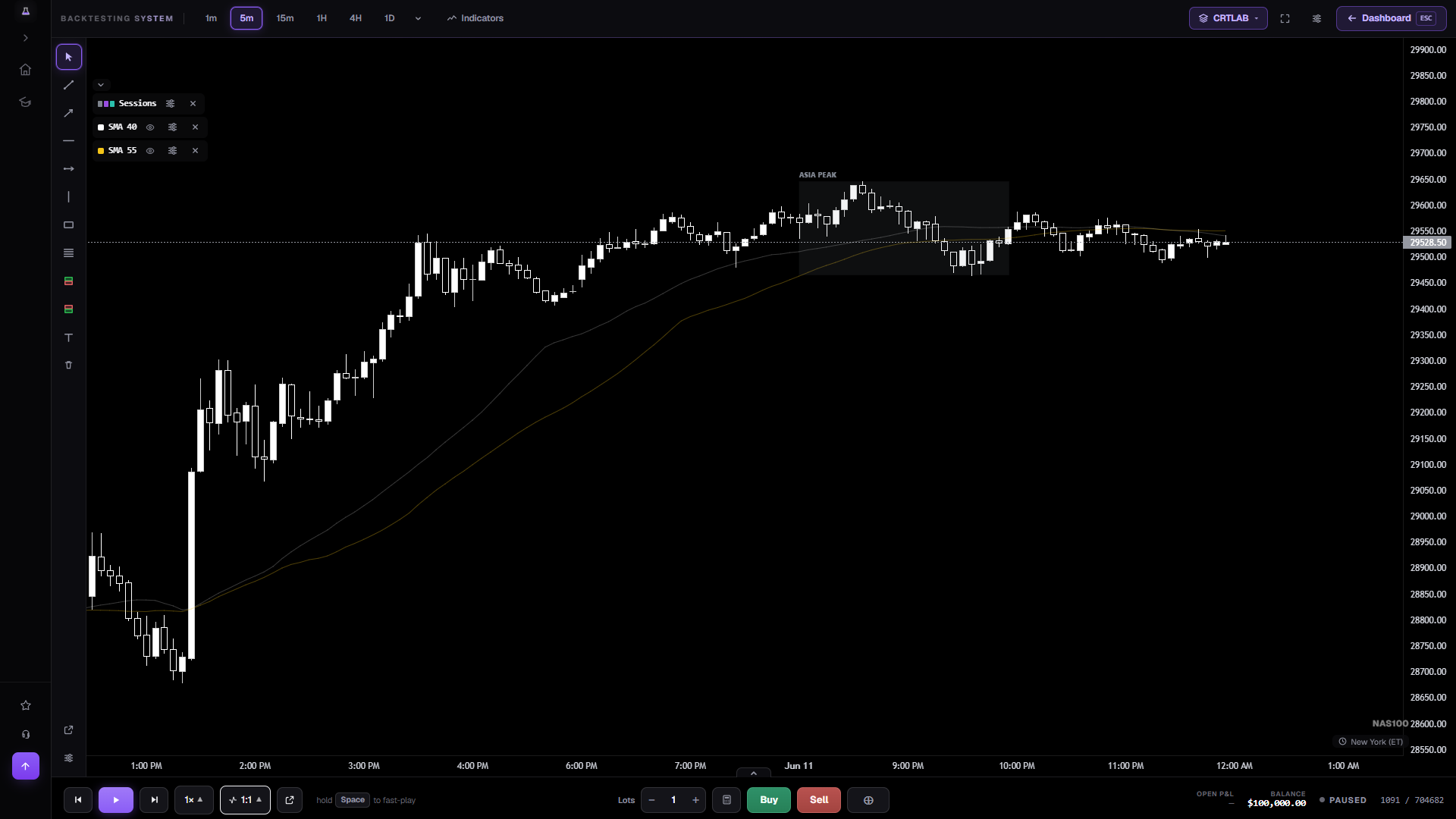
The test almost nobody runs: does your rule stop buying?
Dip-buying strategies are the most common thing retail traders backtest, and the most commonly mis-tested, because they are usually validated on instruments that recovered. On something that kept recovering, "buy the dip" is indistinguishable from "be long". The strategy is only genuinely tested on an instrument where the dips did not come back, and this is that instrument.
So take your rules through 2021 onward specifically and count. How many times did you buy? What was the worst run of consecutive losses? Did anything in your rule set ever say stop? If the answer to the last question is no, you have found the actual risk in your strategy, and you found it for free.
There is a subtler version of the same problem worth checking: many rules include a trend filter, but the filter is often slow enough that it stays bullish through the first third of a decline. Measuring how long your filter took to flip is more useful than knowing that it eventually did.
What the INTC data actually is
The archive runs from May 2018 to the most recent session we hold, on every timeframe from one minute to monthly. It is open from the first chart — there is no plan that unlocks more of it, and no shorter window for people who have not paid.
Equity data here is regular hours only — 09:30 to 16:00 New York, no pre-market and no after-hours. That is not a gap in the data, it is what an equity session is, and it has a consequence worth planning for: every trading day opens with a gap rather than continuing from the previous close, so any rule you carried over from an index future or an FX pair is about to meet a discontinuity it has never been tested against.
Prices are split-adjusted throughout, so a chart of 2019 shows what you would compare against today rather than the raw tape. Getting this wrong is the classic silent equity-backtest bug: an unadjusted series prints a 90% single-day crash on the split date, and a stop-loss rule tested through it produces numbers that mean nothing.
How to backtest INTC without fooling yourself
Step through the decline without skipping. The temptation is to jump to the interesting parts; the whole point is to experience the sequence of trades in the order they arrived, because that is what determines whether you would have kept taking them.
Record the maximum consecutive-loss run, not just the win rate. That number is what actually ends strategies, and the risk of ruin calculator turns it into the probability that matters.
Then run the identical rules on MSFT over the same dates. Same index, same sector exposure, opposite trajectory — the difference between the two results is the size of your survivorship assumption.
Frequently asked questions
Is INTC backtesting free?
Yes, and there is no card and no trial timer. You get Intel back to May 2018, with every tool the product has, for 2,000 candles of replay — about two hours of stepping through a chart. After that you top up for $5, or pay $19.99 once and never think about it again. Nothing you buy expires. This is the one instrument in the catalogue where a dip-buying rule is genuinely tested rather than flattered.
Why is Intel the best stock to test a dip-buying rule on?
Because the dips did not reliably come back. On an instrument that recovered every time, buying dips is indistinguishable from being long, so the rule is never actually tested. INTC's multi-year decline is where a dip-buying rule either has an exit condition or does not.
What should I measure?
The longest run of consecutive losses, and how many bars your trend filter took to turn defensive. Both are more informative than the win rate, and both are what decide whether a strategy survives contact with a regime change.
How far back does INTC go?
May 2018, split-adjusted, regular hours only, on every timeframe from one minute to monthly — which covers both the blue-chip era and the decline.
Open INTC and start stepping
Real Intel history, split-adjusted, one candle at a time. No account, no card, 2,000 candles free.
Open the chart →