

Backtest · MU
Backtest MU — Candle by Candle
Micron is the most honestly cyclical instrument in this catalogue. Memory pricing runs in multi-year boom and bust cycles and the stock follows them closely, which produces something rare and useful for a backtester: long, unambiguous trends with equally long counter-trends, rather than the choppy drift most equities spend their time in. If you are testing a trend-following rule, this is where it either works or does not.
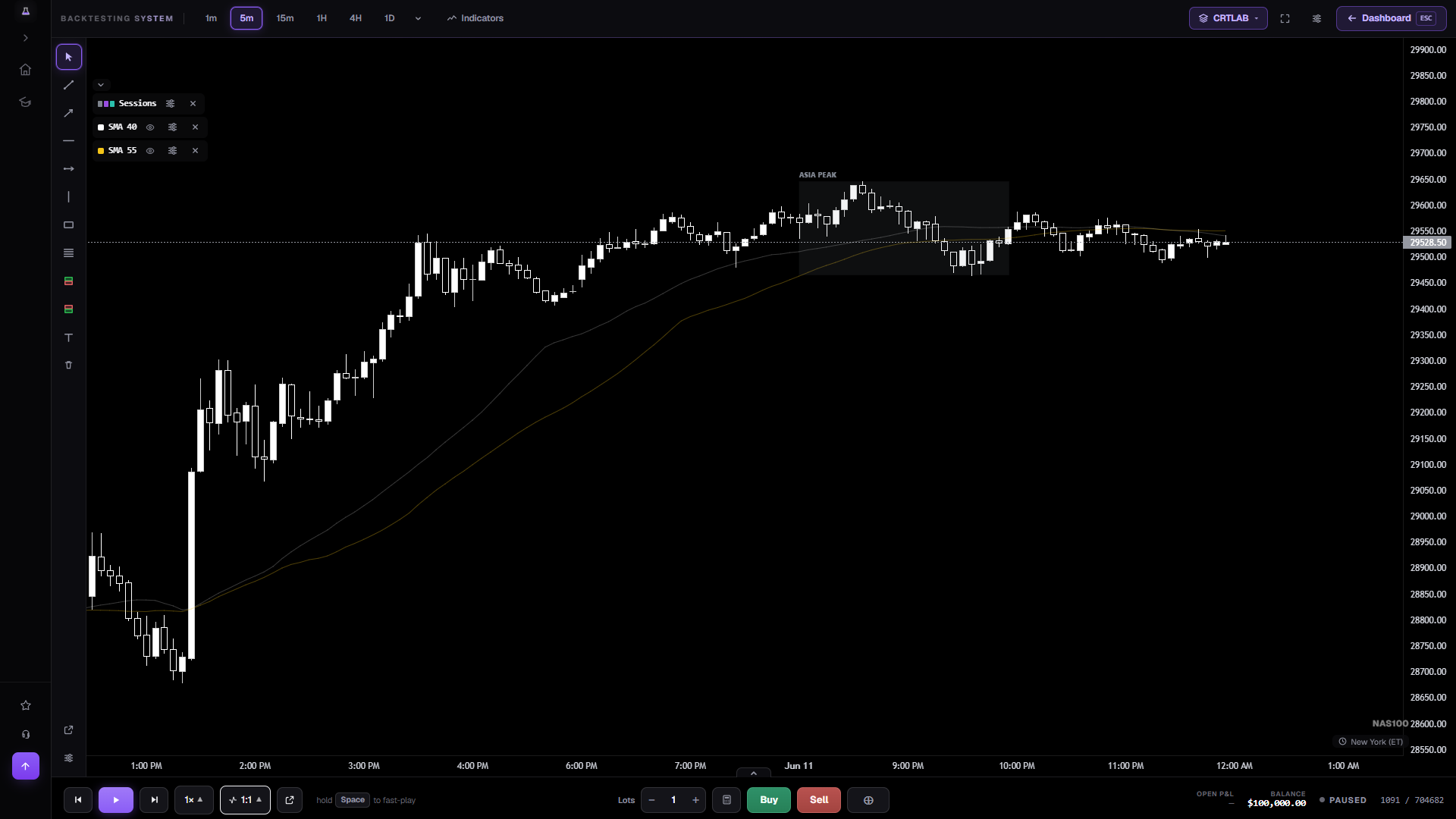
Long trends are a different test to trending days
Most retail trend rules are really intraday momentum rules, and they get tested on instruments where a "trend" lasts three sessions. MU asks a harder question, because its trends last quarters. A rule that gets you in and out repeatedly inside a six-month advance will underperform simply holding — and finding that out is worth more than another win-rate figure.
So run two tests side by side: your rule, and buying the first signal and holding until the opposite signal. If the second beats the first, your exits are costing you more than they save, and that is a specific, fixable diagnosis rather than a vague sense that the strategy underperforms.
The cycle is also why MU is a poor place to validate a rule you intend to use on something like AAPL. What works on a genuinely cyclical name is often a bet on the cycle, and generalising it to a compounder is how a strategy quietly acquires a hidden assumption.
What the MU data actually is
The archive runs from May 2018 to the most recent session we hold, on every timeframe from one minute to monthly. It is open from the first chart — there is no plan that unlocks more of it, and no shorter window for people who have not paid.
Equity data here is regular hours only — 09:30 to 16:00 New York, no pre-market and no after-hours. That is not a gap in the data, it is what an equity session is, and it has a consequence worth planning for: every trading day opens with a gap rather than continuing from the previous close, so any rule you carried over from an index future or an FX pair is about to meet a discontinuity it has never been tested against.
Prices are split-adjusted throughout, so a chart of 2019 shows what you would compare against today rather than the raw tape. Getting this wrong is the classic silent equity-backtest bug: an unadjusted series prints a 90% single-day crash on the split date, and a stop-loss rule tested through it produces numbers that mean nothing.
How to backtest MU without fooling yourself
Test on the daily and 4-hour timeframes first, not the 1-minute. This instrument's edge, if you have one, lives at the timescale its cycle operates on.
Compare against buy-and-hold-until-reversed over the same window. That benchmark is the one most trend backtests avoid, and it is the one that decides whether your exits earn their keep.
The compounding calculator is a useful sanity check here: multi-month holds produce few trades a year, and a small number of large results compounds very differently from many small ones.
Frequently asked questions
Is MU backtesting free?
Yes, and there is no card and no trial timer. You get Micron back to May 2018, with every tool the product has, for 2,000 candles of replay — about two hours of stepping through a chart. After that you top up for $5, or pay $19.99 once and never think about it again. Nothing you buy expires. Eight years covers roughly two full memory cycles, which is the minimum for a trend rule on a cyclical name.
What timeframe should I backtest MU on?
Daily and 4-hour, at least to begin with. Micron's character is a multi-month cycle, so testing a one-minute rule on it tells you about intraday noise rather than about the thing that makes this instrument distinctive.
Why compare against buy-and-hold?
Because on a long-trending instrument, active exits frequently cost more than they save. Running your rule against "enter on the first signal and hold until the opposite one" turns a vague underperformance into a specific diagnosis about your exits.
How far back does MU go?
May 2018, split-adjusted, regular hours only, on every timeframe from one minute to monthly.
Open MU and start stepping
Real Micron history, split-adjusted, one candle at a time. No account, no card, 2,000 candles free.
Open the chart →