

Backtest · QQQ
Backtest QQQ — Candle by Candle
QQQ and NAS100 track the same index, and this is one of the few places you can replay both and find out how much that actually matters. It matters more than most people expect. QQQ is an ETF trading a regular session; NAS100 here is the E-mini future trading nearly around the clock. Same underlying, two genuinely different instruments — and a strategy is usually being tested on the clock, not on the index.
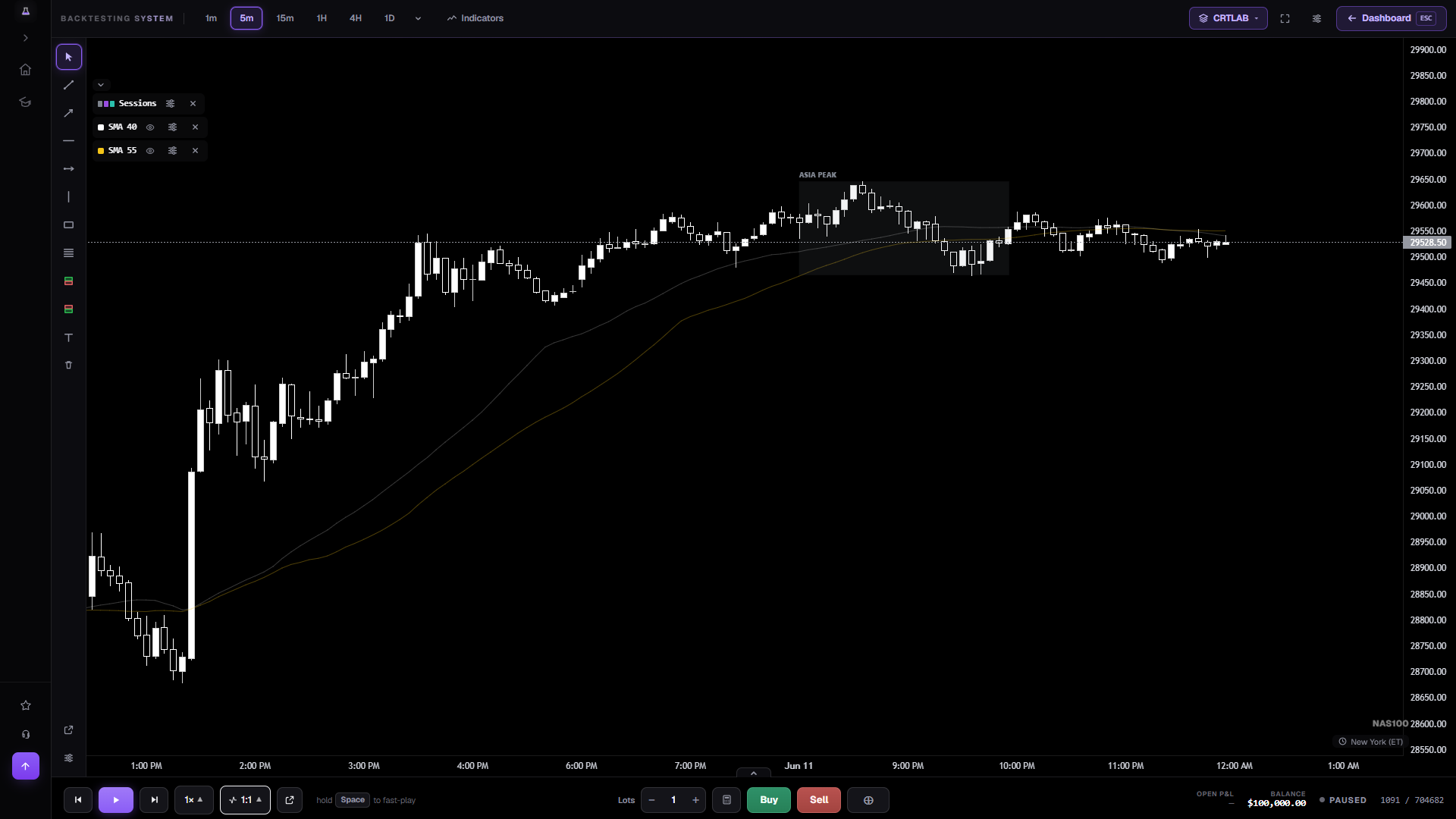
Same index, different instrument — and the difference is the session
The clearest consequence is the overnight move. On the futures chart, the hours between the US close and the next open are visible and tradeable; on QQQ they are a gap. So a rule that reacts to the overnight range can be tested on NAS100 and simply cannot exist on QQQ — while a rule about the cash open behaves more cleanly on QQQ, because the session boundary is real rather than an arbitrary line drawn across continuous trading.
There is a third instrument worth knowing about in the same family: this catalogue also carries NAS100NY, the regular-hours-only variant of the Nasdaq future. That one isolates the cash session on the futures contract, which makes the three-way comparison — ETF, 24-hour future, RTH future — a genuinely useful exercise for anyone deciding what to trade.
The smaller differences are worth stating too. QQQ pays a distribution, which puts a small periodic step in the price that a future does not have; and the ETF is priced in the low hundreds while the future is priced in the thousands, so identical percentage moves look and feel different on the chart.
What the QQQ data actually is
The archive runs from May 2018 to the most recent session we hold, on every timeframe from one minute to monthly. It is open from the first chart — there is no plan that unlocks more of it, and no shorter window for people who have not paid.
Equity data here is regular hours only — 09:30 to 16:00 New York, no pre-market and no after-hours. That is not a gap in the data, it is what an equity session is, and it has a consequence worth planning for: every trading day opens with a gap rather than continuing from the previous close, so any rule you carried over from an index future or an FX pair is about to meet a discontinuity it has never been tested against.
Prices are split-adjusted throughout, so a chart of 2019 shows what you would compare against today rather than the raw tape. Getting this wrong is the classic silent equity-backtest bug: an unadjusted series prints a 90% single-day crash on the split date, and a stop-loss rule tested through it produces numbers that mean nothing.
How to backtest QQQ without fooling yourself
Run the same rule set on QQQ and on NAS100 across the same dates and compare the two equity curves. Where they diverge tells you what your strategy is actually keyed to.
If the divergence is concentrated at the open, that is a session effect rather than an index effect, and the New York session backtester is the tool for isolating it.
Do not average the two results together. They are one underlying observed twice, not two independent samples — the same correlation trap described on the AMD page.
Frequently asked questions
Is QQQ backtesting free?
Yes, and there is no card and no trial timer. You get QQQ back to May 2018, with every tool the product has, for 2,000 candles of replay — about two hours of stepping through a chart. After that you top up for $5, or pay $19.99 once and never think about it again. Nothing you buy expires. NAS100 and its regular-hours variant are open on the same terms, which is what makes the side-by-side comparison possible.
What is the difference between backtesting QQQ and NAS100?
The session. QQQ is an ETF trading 09:30 to 16:00 New York, so the overnight move arrives as a gap; NAS100 here is the E-mini future trading nearly around the clock, so the same move is visible and tradeable. A strategy that behaves differently on the two is keyed to the clock rather than to the index.
Is QQQ split-adjusted and dividend-aware?
The series is split-adjusted like every equity here. QQQ pays a periodic distribution, which puts a small step in the price that a futures contract does not have — worth knowing if you are comparing long-horizon results between the two.
Should I test on QQQ or TQQQ?
QQQ first, always. TQQQ is a 3x daily-rebalanced product whose returns are not three times QQQ's over any period longer than a day — see <a href="/backtest-tqqq">the TQQQ page</a> for what that does to a backtest.
Open QQQ and start stepping
Real the Nasdaq 100 ETF history, split-adjusted, one candle at a time. No account, no card, 2,000 candles free.
Open the chart →