

Backtest · COIN
Backtest COIN — Candle by Candle
Coinbase is the most interesting instrument in this catalogue for one structural reason, and it is not that it tracks Bitcoin. It is that it tracks Bitcoin on an equity clock. BTC trades continuously; COIN trades 09:30 to 16:00 New York. So every Coinbase session opens having already absorbed seventeen and a half hours of crypto movement that you could watch happen and could not trade.
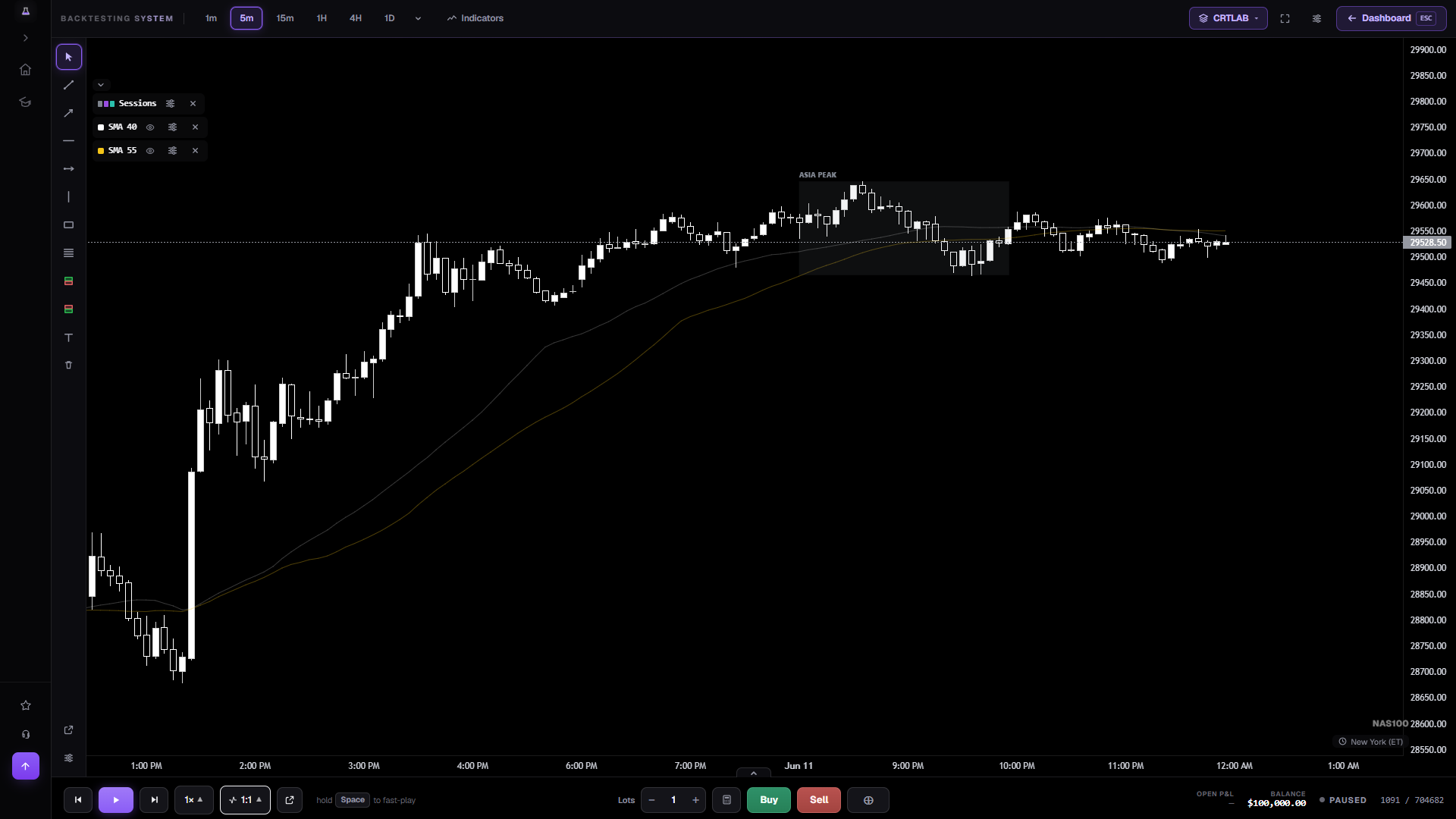
The opening gap already contains information you had
This is a genuinely unusual test to be able to run, and CRTLAB is one of the few places you can run both sides of it: replay BTCUSD overnight, then replay COIN's open the following morning, and find out how much of the overnight crypto move was already priced into the equity by 09:30 — and how much was not.
The answer is not "all of it", which is what makes it worth measuring rather than assuming. If some of the move systematically continues after the open, that is a testable edge with an obvious mechanism. If it is fully priced, that is equally worth knowing, and it will stop you building a strategy on an intuition that does not hold.
The other thing COIN offers is a genuine crypto bear market with equity mechanics: the archive starts at the April 2021 direct listing, so it contains the whole of the 2022 decline and the recovery after it. Note that a direct listing has no IPO price and no lock-up in the usual sense, so the early-listing caveats that apply to ARM apply differently here.
What the COIN data actually is
The archive runs from April 2021 to the most recent session we hold, on every timeframe from one minute to monthly. It is open from the first chart — there is no plan that unlocks more of it, and no shorter window for people who have not paid.
Equity data here is regular hours only — 09:30 to 16:00 New York, no pre-market and no after-hours. That is not a gap in the data, it is what an equity session is, and it has a consequence worth planning for: every trading day opens with a gap rather than continuing from the previous close, so any rule you carried over from an index future or an FX pair is about to meet a discontinuity it has never been tested against.
Prices are split-adjusted throughout, so a chart of 2019 shows what you would compare against today rather than the raw tape. Getting this wrong is the classic silent equity-backtest bug: an unadjusted series prints a 90% single-day crash on the split date, and a stop-loss rule tested through it produces numbers that mean nothing.
How to backtest COIN without fooling yourself
Run the two instruments as a pair. Step BTCUSD through the overnight window, note where it closed relative to the previous US session, then open COIN and record the gap. Thirty or forty of those and you have a real distribution.
Be strict about the direction of information. You are testing whether the overnight move predicts the equity open and what follows it — not whether the equity move explains the overnight one after the fact.
Size for the gap, not for the intraday range. The position size calculator matters more than usual on an instrument whose largest moves happen while it is closed.
Frequently asked questions
How far back does COIN go?
April 2021, its direct listing — which is the whole history of the stock. That window contains the 2022 crypto decline in full and the recovery afterwards.
Is COIN backtesting free?
Yes, and there is no card and no trial timer. You get Coinbase from its April 2021 listing, with every tool the product has, for 2,000 candles of replay — about two hours of stepping through a chart. After that you top up for $5, or pay $19.99 once and never think about it again. Nothing you buy expires. BTCUSD is open on the same terms, which is what makes the overnight-gap test on this page possible.
Why is Coinbase interesting to backtest alongside Bitcoin?
Because Bitcoin trades continuously and Coinbase does not. Every COIN session opens having already absorbed seventeen and a half hours of crypto movement, so the opening gap is a measurable question: how much of the overnight move was priced by 09:30, and how much continued afterwards?
Does COIN just track Bitcoin?
It is strongly correlated, but not identically — it is an operating business with revenue, costs and its own equity-market flows, and the correlation itself changes across the archive. Testing that assumption rather than accepting it is one of the more useful things this pair allows.
Open COIN and start stepping
Real Coinbase history, split-adjusted, one candle at a time. No account, no card, 2,000 candles free.
Open the chart →