

Backtest · META
Backtest META — Candle by Candle
META carries a data problem that most free equity datasets get silently wrong, and it is worth knowing about whichever tool you end up using. The company traded as FB until 9 June 2022. Before that date the META ticker belonged to a completely different, tiny company — Meta Materials. Pull "META since 2018" from a naive source and you get Meta Materials' price history welded onto Facebook's, which is not a chart of anything.
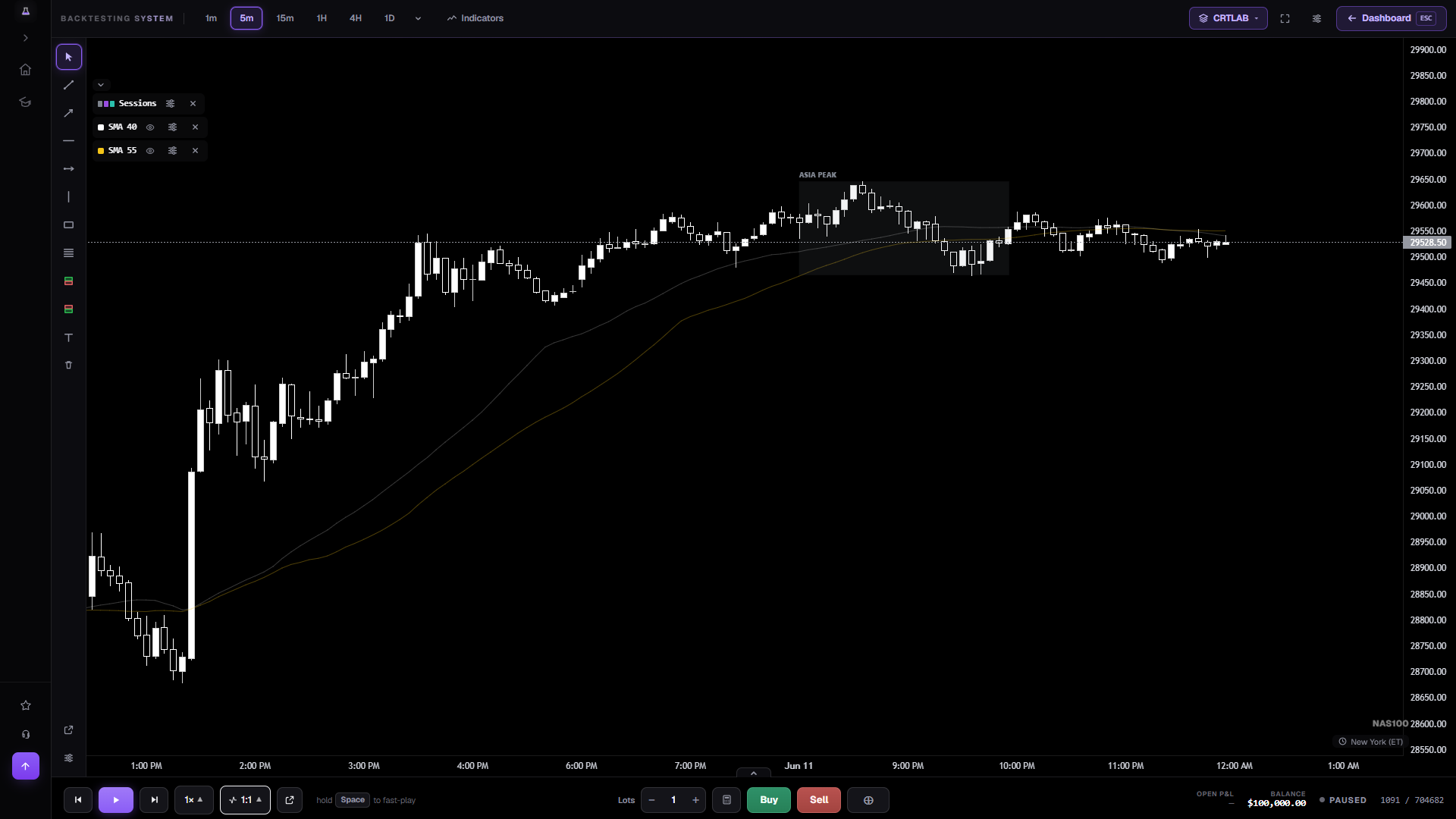
The ticker change, and why this archive is joined at it
The series here is built by pulling the FB era separately and joining it to META at the ticker change, so what you replay from 2018 is one continuous history of one company. That is a real correction that had to be made deliberately — it was found and fixed during the data rebuild, and it is the kind of defect that produces a beautifully profitable backtest for reasons that have nothing to do with your rules.
It is also a good general lesson about backtesting equities: a ticker is not an identity. Companies rename, relist and change symbols, and a dataset that keys on the symbol rather than the entity will happily hand you two businesses in one file.
What the archive then contains is one of the most useful drawdowns available anywhere for testing risk rules: from November 2021 to November 2022 the stock lost roughly three quarters of its value, in a long series of steps rather than one crash. Almost every trend-following rule survives a fast crash. Far fewer survive a slow one.
What the META data actually is
The archive runs from May 2018 to the most recent session we hold, on every timeframe from one minute to monthly. It is open from the first chart — there is no plan that unlocks more of it, and no shorter window for people who have not paid.
Equity data here is regular hours only — 09:30 to 16:00 New York, no pre-market and no after-hours. That is not a gap in the data, it is what an equity session is, and it has a consequence worth planning for: every trading day opens with a gap rather than continuing from the previous close, so any rule you carried over from an index future or an FX pair is about to meet a discontinuity it has never been tested against.
Prices are split-adjusted throughout, so a chart of 2019 shows what you would compare against today rather than the raw tape. Getting this wrong is the classic silent equity-backtest bug: an unadjusted series prints a 90% single-day crash on the split date, and a stop-loss rule tested through it produces numbers that mean nothing.
How to backtest META without fooling yourself
Run your stop and exit rules through the 2021–2022 decline specifically and count how many times they got you out versus how many times a bounce pulled you back in. That ratio is the honest measure of whether a rule cuts losers.
Then run the recovery. Rules tuned to survive the decline frequently miss the entire move back up, and finding that out in replay costs nothing.
Log everything in R and size with the position size calculator. The drawdown recovery calculator is the one to have open beside this particular stock, because it makes the arithmetic of a 75% fall concrete.
Frequently asked questions
Does the META data include the Facebook era?
Yes, and correctly. The company traded as FB until 9 June 2022; that era is pulled separately and joined to META at the ticker change, so the series is one continuous history of one company rather than Meta Materials spliced onto Facebook.
Is META backtesting free?
Yes, and there is no card and no trial timer. You get Meta Platforms back to May 2018, with every tool the product has, for 2,000 candles of replay — about two hours of stepping through a chart. After that you top up for $5, or pay $19.99 once and never think about it again. Nothing you buy expires. That includes the FB era, joined at the June 2022 ticker change.
What is the most useful thing to test on META?
Risk rules through the November 2021 to November 2022 decline, which took roughly three quarters off the price in a long series of steps. A slow, stepped drawdown defeats far more stop-loss rules than a single fast crash does, and this is the clearest example of one in the catalogue.
Is the data split-adjusted?
Yes, throughout — as is every equity series here. META has not split in this window, but the same adjustment pipeline is applied to all seventeen names.
Open META and start stepping
Real Meta Platforms history, split-adjusted, one candle at a time. No account, no card, 2,000 candles free.
Open the chart →