

Backtest · GOOGL
Backtest GOOGL — Candle by Candle
Alphabet is the megacap most likely to make a backtest look better than it was, because it spends unusual amounts of time in clean, wide ranges — and a range is the easiest structure in the world to trade in hindsight. Almost every mean-reversion rule looks excellent on a GOOGL chart you have already seen. The only way to find out whether it works is to have the right-hand side covered while you take the trade.
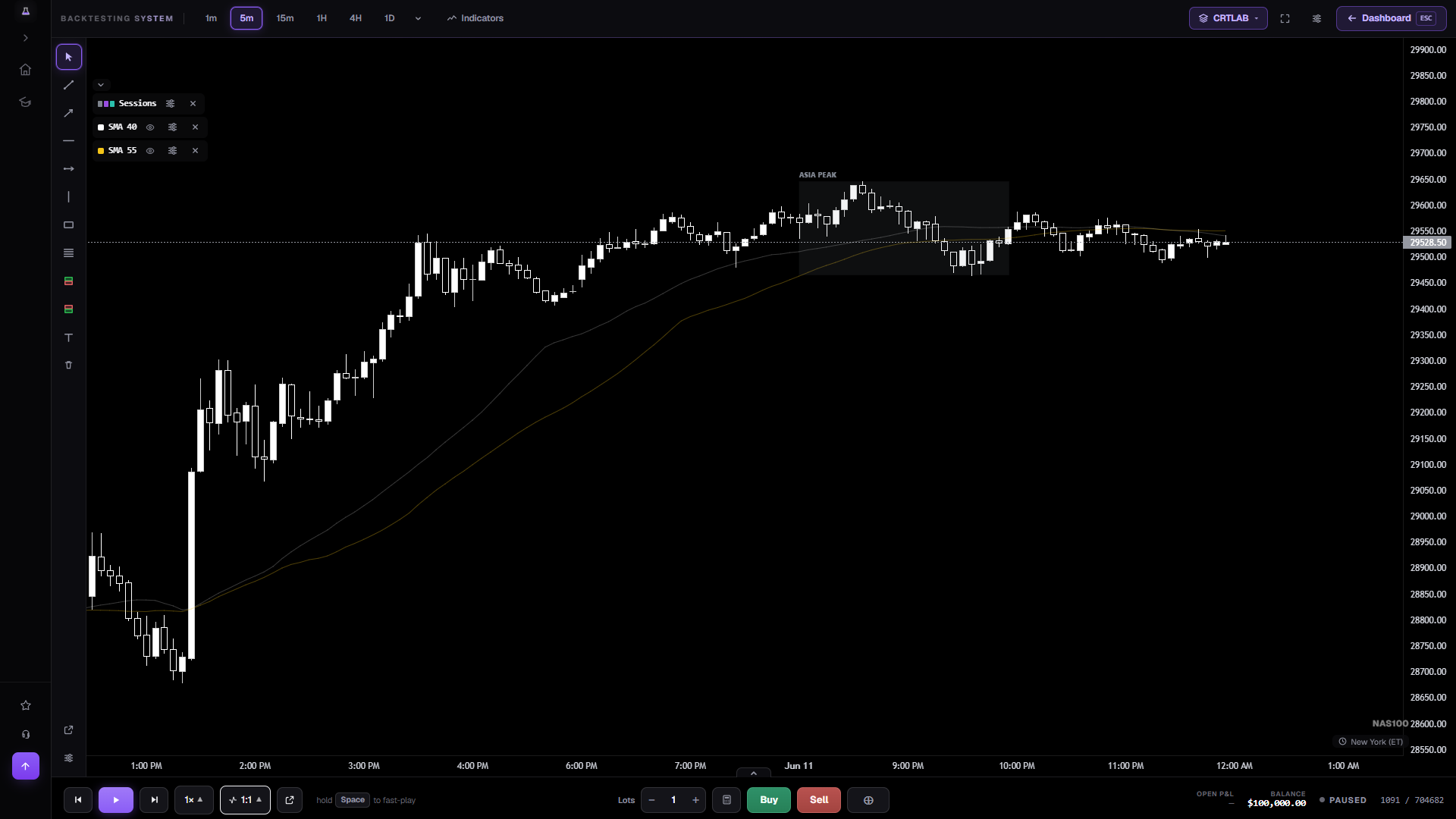
The stock that most rewards hiding the future
This is the general argument for bar-by-bar replay over an equity curve, and Alphabet is where it bites hardest. A range only looks like a range once both edges have printed. Live, the third touch of a level and the breakout that ends the range are indistinguishable until after the fact — and a backtest that scrolls a finished chart cannot tell them apart either, because you already know which one it was.
So the rule to write down before you start is the one that decides, at the level and with no future information, whether you are fading it or waiting. Then step forward and find out how often you were wrong. That number is usually humbling and always useful.
The mechanics: GOOGL split 20-for-1 in July 2022 and the archive is back-adjusted through it, so pre-2022 bars are priced around a twentieth of the tape. Note also that this is the GOOGL class specifically, not GOOG — they track each other closely but they are separate listings, and mixing them is a small, avoidable source of error.
What the GOOGL data actually is
The archive runs from May 2018 to the most recent session we hold, on every timeframe from one minute to monthly. It is open from the first chart — there is no plan that unlocks more of it, and no shorter window for people who have not paid.
Equity data here is regular hours only — 09:30 to 16:00 New York, no pre-market and no after-hours. That is not a gap in the data, it is what an equity session is, and it has a consequence worth planning for: every trading day opens with a gap rather than continuing from the previous close, so any rule you carried over from an index future or an FX pair is about to meet a discontinuity it has never been tested against.
Prices are split-adjusted throughout, so a chart of 2019 shows what you would compare against today rather than the raw tape. Getting this wrong is the classic silent equity-backtest bug: an unadjusted series prints a 90% single-day crash on the split date, and a stop-loss rule tested through it produces numbers that mean nothing.
How to backtest GOOGL without fooling yourself
Define the fade-or-wait decision in writing first. If you cannot state it without reference to what price did next, it is not a rule and the backtest will not test it.
Work in R rather than dollars, for the split reason described on the Amazon page — the same 20-for-1 arithmetic applies here.
Use the sample size calculator before you conclude anything. Range-trading edges tend to be small per trade, and small edges need large samples before the result clears noise.
Frequently asked questions
Is GOOGL backtesting free?
Yes, and there is no card and no trial timer. You get Alphabet back to May 2018, with every tool the product has, for 2,000 candles of replay — about two hours of stepping through a chart. After that you top up for $5, or pay $19.99 once and never think about it again. Nothing you buy expires. This is the GOOGL share class specifically, not GOOG — they are separate listings and mixing them introduces avoidable error.
Is the 20-for-1 split handled?
Yes. The July 2022 split is back-adjusted, so every earlier bar is divided by twenty and percentage moves stay comparable across the whole archive. Work in R rather than dollars and the adjustment is invisible to your results.
Is this GOOGL or GOOG?
GOOGL, the Class A listing. The two classes track each other closely but they are different instruments with different prices, and a backtest that mixes them is measuring a spread it did not intend to.
What does GOOGL test well?
Range and mean-reversion rules — but only under replay conditions. It is the stock where the difference between testing a rule and admiring a finished chart is widest, because ranges are obvious in retrospect and ambiguous at the time.
Open GOOGL and start stepping
Real Alphabet history, split-adjusted, one candle at a time. No account, no card, 2,000 candles free.
Open the chart →